

Perhaps you've already learned a few words in Japanese to prepare for your future trip to the archipelago. But know that this isn't necessarily enough. In Japan, body language is an integral part of a conversation, so you need to know what to do and how to interpret these small everyday gestures.
Our Western gestures actually have little in common with those used in Japan. Here's a little guide to the expressions to adopt to be sure you're understood.
Greeting
To greet someone, it's customary to lean the upper body slightly forward while keeping your arms at your sides. This represents a mark of respect that can be used for a hello, a goodbye and even a thank you.
But as everything is codified in Japan, this way of greeting may undergo some adaptations depending on the person in front of you. This is the case according to the person's status, their position in the hierarchy, their age, their gender, your degree of closeness, etc. In any case, the way described above remains the simplest and you won't risk making any real mistake by applying it.
This posture is not to be confused with the one expressing "enjoy your meal". You also lean the upper body forward, while joining both hands in front of the chest this time. You do it before starting the meal and accompany it with an "Itadakimasu".
Note also that between close friends, the way of greeting stays at a distance. A simple wave of the hand is enough — no hugs or embraces.
Saying no
The Japanese find it very hard to express negation directly when you ask them a question. It's indeed not in the culture to say "no". However, when they have to answer this way, they become quite embarrassed. It's their gestures that will let you detect the answer.
On one hand, you'll see it very quickly on their face: they'll look confused, with a slightly vacant gaze and clenched teeth. Most men will then place their hand behind their head, as if to scratch the back of their neck. Women, for their part, will place both hands in front and shake them as a sign of refusal. To be honest, these gestures are no longer really gendered today, and both men and women can use them.
Counting
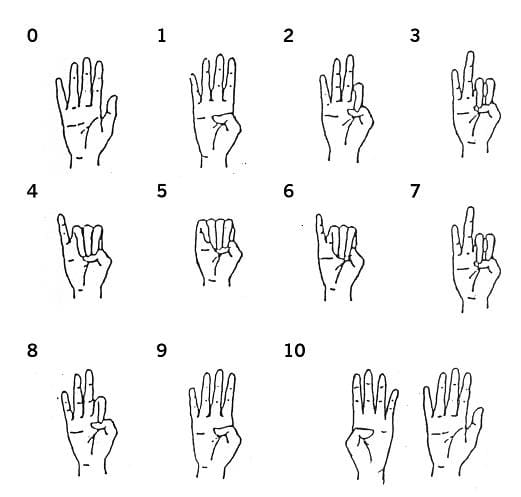
While, like us, the Japanese use their fingers to count, you'll quickly realise it's not in the same way. You may be somewhat confused, thinking they're counting backwards.
In Japan, when you want to count on your hands, they start open. It's by folding a finger down that you begin to count — the opposite of us, who raise a finger. So for the number 3, for example, where for us the thumb, index and middle finger are raised... it'll be the opposite for the Japanese.
And when you go beyond 5, the fingers rise again to continue counting. But there's nothing better than an illustration to understand the logic:
Other everyday gestures
- Making your way through a crowd
While apologising, raise your arm with your hand at face level. Lower your head and try to part the crowd.
- Talking about yourself
To point to ourselves, we in France usually touch our chest with the palm of the hand or the index finger. In Japan, you point to the tip of your nose with that same finger.
- Talking about a loved one
Legend has it that people who love each other are linked by an invisible thread at the little finger. So, when talking about their partner, many will tend to raise their little finger.
- The OK sign with the fingers
This sign, well known to everyone, consisting of forming a circle with the index finger and thumb while leaving the other fingers raised, also lets you give your agreement or say that all is well in Japan. However, beware of the context: this gesture can also evoke an attraction to money.
- Beckoning someone to you
While in France we signal someone to join us with the hand turned upwards, it's the opposite in the archipelago. The palm is turned towards the ground and the bending of the fingers serves as the call.


