

Although in France we have the culture of the bouquet and the habit of giving flowers when we're invited, their meaning remains very vague and we don't attach great importance to their composition.
Ikebana, translated as 'the art of bringing flowers to life' and therefore the art of floral arrangements, has been practised in Japan for more than 600 years. This traditional art originates in the offering of flowers in temples. Over the centuries, its evolution gave birth to numerous Schools, among which the Ohara school, founded in 1895, fits fully into the Japonism movement.
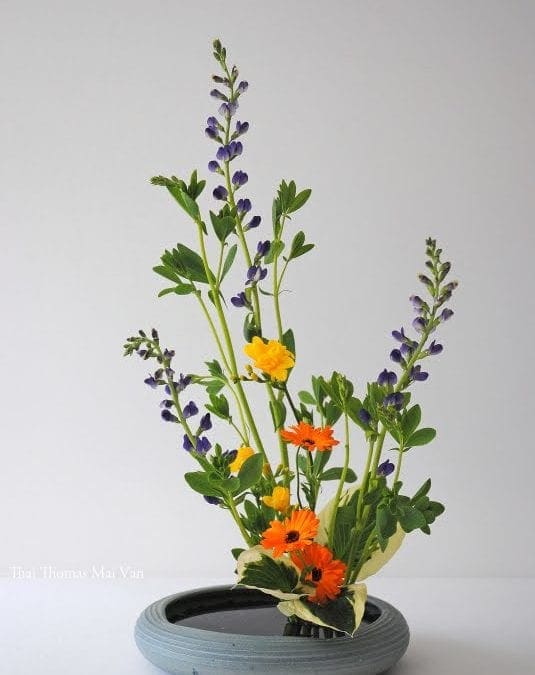
For millennia, flowers were used as a devotional offering, but in Japan things evolved over the centuries until becoming one of the most appreciated art forms of Japanese quintessence.
First practised by monks, the popularity of Ikebana in Japan shifted from the environment of monks and samurai to women and artists. Its formal standards continued to evolve in a surprising and ever more artistic way.
Ikebana, or the art of floral sculptures
Although Ikebana is a floral art, it doesn't only consist of emphasising the beauty of flowers and the harmony of colours as with us. For the Japanese, the entire design takes on particular importance. Ikebana showcases the flower, the shape of the plant, but also the leaves, the stems and even the pot in which it rests. They showcase beautiful flowers, but also buds and withered flowers, and all this always with great respect. The structure of the floral arrangement is built around three symbols: heaven, earth and humanity. A bit like Japanese gardens, which are meant to represent nature in the broad sense.
The structure, or form, of Ikebana — literally: "flowers kept alive" — has always been the essential element. Ikebana masters teach according to sophisticated diagrams that show the precise angles of the branches, flowers and other elements held at eye level and higher still. An Ikebana arrangement looks almost natural, but it's in fact a stylised form, which takes several years to master.
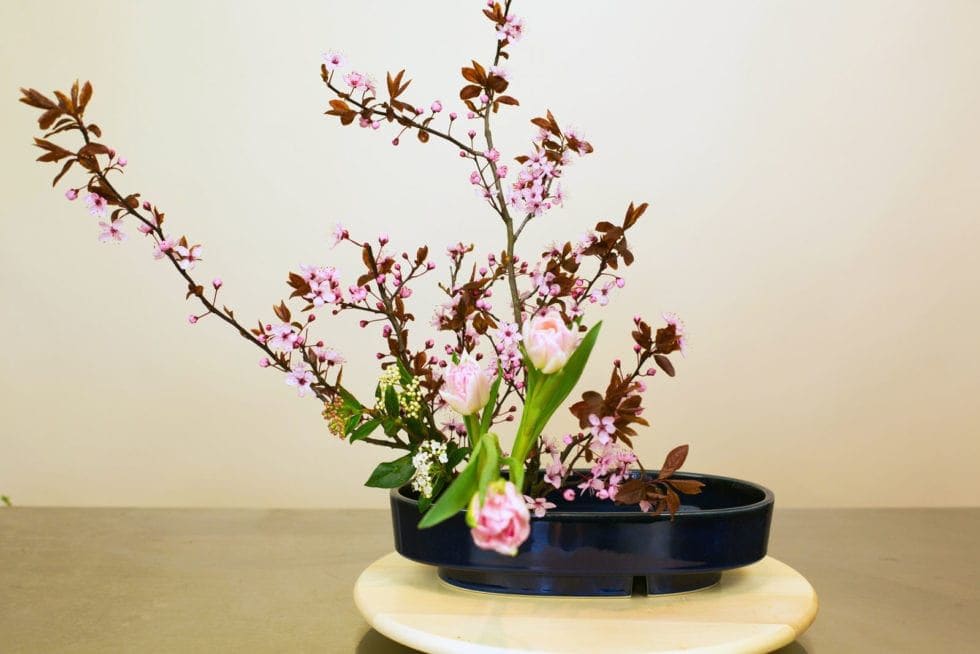
Ikebana uses asymmetry and the arrangement of space in the composition. The flower doesn't have an exceptional place there. Instead, each branch, each stem, each bud, is carefully arranged and balanced with all the other elements.
The Moribana style is the basis of Ikebana. It's both simple "vertical" forms and more complex "oblique" ones. Each element has a name (shin, soe and hikae) and the lengths of each element are determined by complex formulas.
Quote on Ikebana
"Whoever wishes to express themselves through this creative technique must first look at nature, this nature within which we live. The essential thing is that the created arrangement bears witness to a sincere observation and a real understanding of nature: that is the very heart of the true spirit of Ikebana." Houn Ohara (1908-1995), 3rd director of the Ohara school.
Practised today in several countries of the world, the art of Ikebana has thus been enriched by the flavours of each country, but remains one of Japan's artistic forms. Ikebana is therefore an art in perpetual evolution. There are a little more than 3,000 schools in all countries. 3,000 establishments where, more than 1,000 years after its invention, the Japanese perpetuate this art of making flowers speak.


