

Yes, yes, you read that right: a superstar that's nothing but a hologram. It seems surprising, baffling, even uninteresting to some — and yet!
For more than 10 years, the character of Hatsune Miku has been a phenomenon in Japan. And the virtual singer has won over the world, since the French seem charmed too. In early 2020, a concert at the Zénith de Paris drew the crowds, to the great delight of French-speaking fans.
Who is Hatsune Miku?
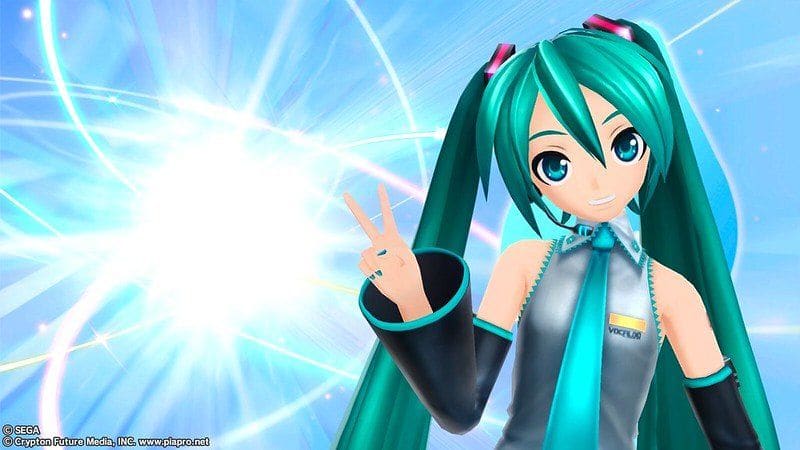
You have to go back to 2003 to know the beginnings of such a project. The Yamaha brand announced the development of VOCALOID, a computer program that recreates songs by combining pre-recorded melodies and lyrics. This technology already made it possible to create virtual singers able to perform a wide musical repertoire, but like all first attempts, the project developed and improved.
And that's where Hatsune Miku was born, virtually, on 31 August 2007, on the screens of the company Crypton Future Media for the second version of VOCALOID. A female character with long turquoise hair and naturally inspired by the manga universe, little information is ultimately revealed about her. We simply know that she was 16 at the time (has she aged since?), that she's 1.58 m tall and weighs 42 kg. With an outfit largely inspired by schoolgirl uniforms and Yamaha synthesisers, always in turquoise tones, she has a Welsh onion as her totem object.
Hatsune Miku literally means "First sound of the future", and other improvements have been made to this personification over the years. From 2008, a program let the star perform choreography to her music. In 2010, it was her voice that benefited from technological advances, becoming more and more human. And with VOCALOID 3 in 2013, Hatsune no longer sang only in Japanese, but also in English, and could perform more than 100,000 songs.
A real phenomenon
From its first months, its first years of activity, the character of Hatsune Miku of course attracted attention, but also enjoyed success. More and more songs with her voice emerged online, and the singer's videos — initially broadcast on a Japanese site — quickly ended up on the benchmark platform, YouTube. The phenomenon was launched!
A whole universe was created around Hatsune and other characters emerged, such as her evil double who would be named Zatsune Miku. The fans are also content creators, and a real fan base emerged, flooding the web with their productions and blogs related to the singer.
2009 was a big year for the character's "career". First of all, the young singer became the main character of a first arcade game before being so for other video games for PlayStation, Nintendo, etc. But it was also the year of the first concerts! As crazy as it may seem, Hatsune Miku now performs on stage, in front of a real audience. The demand from fans was too strong and her creators couldn't resist the urge to build real shows around the phenomenon. Through a projection system and then by hologram, thousands of spectators were able to attend performances by their virtual idol. No autograph or interview, sure, but a milestone for the character and the technology.
In 2014, the very real Lady Gaga even announced Hatsune Miku as the opening act of a series of concerts in the United States. Needless to say, shows all over the world have been given since, which is a first for what is, originally, a simple character. A true social phenomenon, she even had the chance to perform on David Letterman's talk show.
Fans & merchandise
Hatsune's fan base is now one of the most solid and extends beyond Asia, as you've seen. In Japan and China in particular, she is often cited among the most appreciated singers.
While in Japan 60% of these fans are men, the trend is different around the world. In Europe, for example, it's a much more diverse and mostly family audience. The European shows have moreover greatly attracted families, parents accompanying their children and teenagers in particular. An unofficial fan Instagram account has more than 109,000 followers to date.
A true internet character, Hatsune also found herself propelled into manga (nothing abnormal given the aesthetic), into various video games where she was either the main character or a guest, and onto a whole host of goodies bearing her likeness. A pop-culture icon, many cosplayers now opt for her blue pigtails during conventions.
Are you a Hatsune Miku fan?
Do you understand the enthusiasm around a virtual character?


