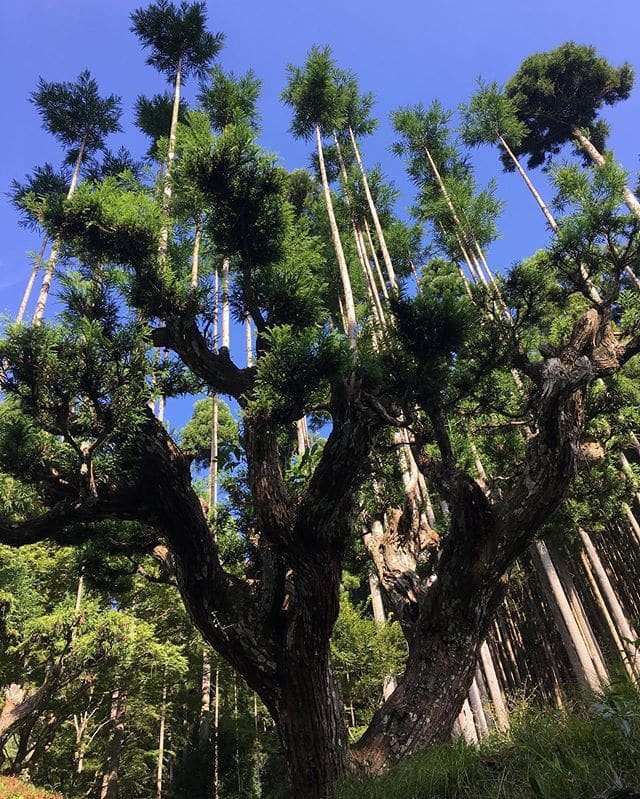
It's not a new technique, and yet it's been talked about again for some time — and for good reason! Daisugi (台杉) is a technique at least 8 centuries old that allows large quantities of wood to be harvested, without cutting down a tree entirely.
Intriguing, but not impossible thanks to a well-studied pruning process. We'll explain everything.
One stump, several trees
Daisugi, literally "cedar table", was invented notably to answer architectural problems of the 13th century. At that time, Sukiya-zukuri was developing rapidly in Japan. This trend, advocating the use of natural materials for the construction and decoration of homes, was therefore very wood-hungry.
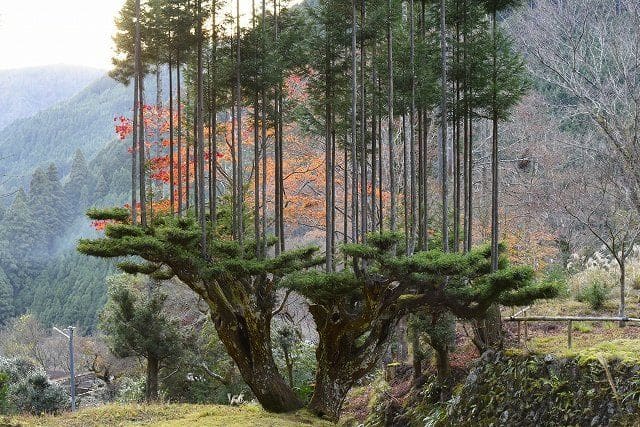
So, to make up for the lack of space for extending forests, a method appeared that pushed Japanese cedars to develop more vertically. To do this, the shoots are pruned in such a way that only those growing upwards are kept. The cedar thus resembles a giant bonsai with long stems pointing skyward, giving it an unnatural but spectacular appearance.
Generally, a cedar stump can host more than a dozen new "trunks", born on the already existing tree. With this "traumatising" way of pruning the conifer, the long shoots that develop are straight, flexible and knot-free, therefore less brittle. Ideal characteristics for building frames or other construction elements.
Up to 300 years of harvest
In order to obtain optimal yield from these trees, which naturally develop faster than others, the pruners carry out maintenance every 2 to 4 years. The aim of the operation is to prevent the tree from spreading widthways, but also to remove the branches that could grow on the vertical shoots. All that remains then are bare stems with a few leaves at the top.
The shoots (now trunks) are collected about every 20 years, in order to obtain sufficient length and solidity. All the shoots of the same cedar can be felled at the same time, or partially.
As cedars are robust and have significant growth, it's possible to obtain new shoots for more than 300 years on the same tree. So it's not uncommon to come across stumps of old cedars that were used for the Daisugi technique in Japanese forests, notably in the Kitayama forest, north of the city of Kyoto where it was widely practised.
An alternative against deforestation?
The world's forests are suffering the same fate. Like the Amazon, deforestation is raging in many regions of the globe, for several reasons: agricultural expansion, the development of urban areas, infrastructure projects... There's renewed interest in Daisugi notably for this reason. Buzzing on social media, many internet users see in this technique an alternative way to fight the destruction of our forests.
Spreading less than a forest while obtaining a similar yield, growing trees on a tree could well become a new way of producing wood en masse to meet our needs without "killing" a plant. It's also an excellent way to obtain already-mature cuttings, to replant, during forest-area development projects.
Although endemic to Japan, the Japanese cedar has been introduced to other Asian countries as well as to Europe for mass wood production. In France, it's found notably in Languedoc-Roussillon, Normandy, the south-west, Limousin, Brittany and on the island of Réunion.
Photo credits: Wrath Of Gnon