

Do people proudly display their tattoos in Japan? Is this discipline as well regarded as in the West? Well, not really. The history between Japan and body art has always been complicated and is still associated today with its past use. We'll explain...
The complicated history of tattooing in Japan
Let's not beat around the bush: if tattooing still has such a bad reputation in Japan today, it's because it was historically intended for classes or people who weren't necessarily the country's pride. Between clan stories and social affiliations, let's take a quick overview of the use of tattooing in Japanese culture.
Tattooing arrived in the archipelago at the same time as the first peoples who decided to settle there. Mostly originating from China, they formed the Ainu. This aboriginal ethnic group, of whom a few members survive today, notably took up residence in the far north of the country.
Tattooing was very widely used among women in particular, who from puberty could count several. Beyond the arms, most were also tattooed on the genitals, the forehead and the mouth. And it's this last motif that would most mark history. Could it be one of the inspirations for the Joker's make-up? Not certain. But to indicate that they were married, women sported a sort of big smile or wide moustache in ink. As for men, tattoos were more used as a sign of belonging to groups, or according to their profession.
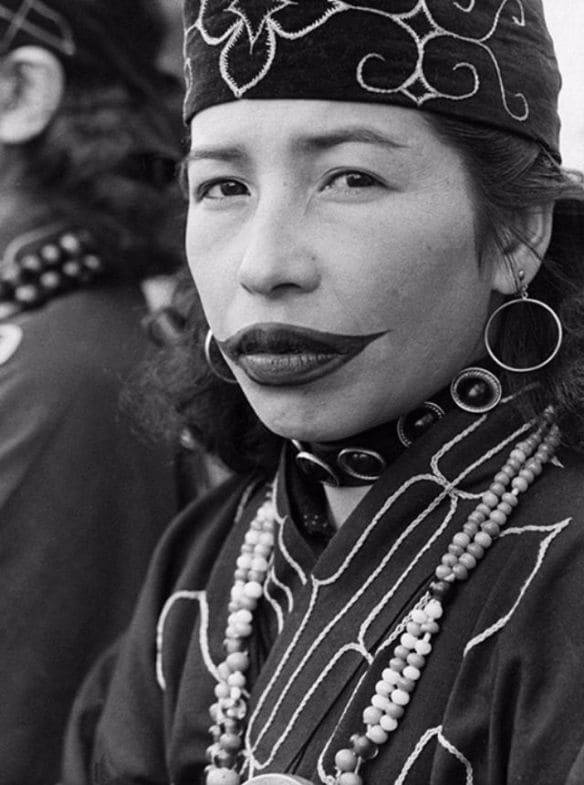
Although the aesthetics of these tattoos remain totally debatable, it wasn't decried for all that. With the rise of the Buddhist religion in the country, tattooing — then perceived as mutilation of the body — became a punishment. And it was from then on that displaying body art became totally negative.
Because indeed, the authorities, wishing to punish criminals (for life, then), had established a tattoo code to apply to them according to the crime committed. These were notably circles around the arms or symbols on the forehead. This indelible punishment, ultimately less radical than the amputations of ears or noses practised until then, nonetheless remained in force until the end of the 19th century and the Meiji era.
The yakuza, members of criminal groups, however also developed a very particular fondness for tattooing, which doesn't benefit it either. Each yakuza, to prove his belonging and his eternal loyalty to the organisation he's part of, would have a large part of his body covered in tattoos (notably the sides). Their tattoos are also the "summary" of their crimes and their acts of courage. Still active today, yakuza gangs are present all over the world and keep this tradition alive. So ask yourself the right questions if you come across a person sporting this type of tattoo!
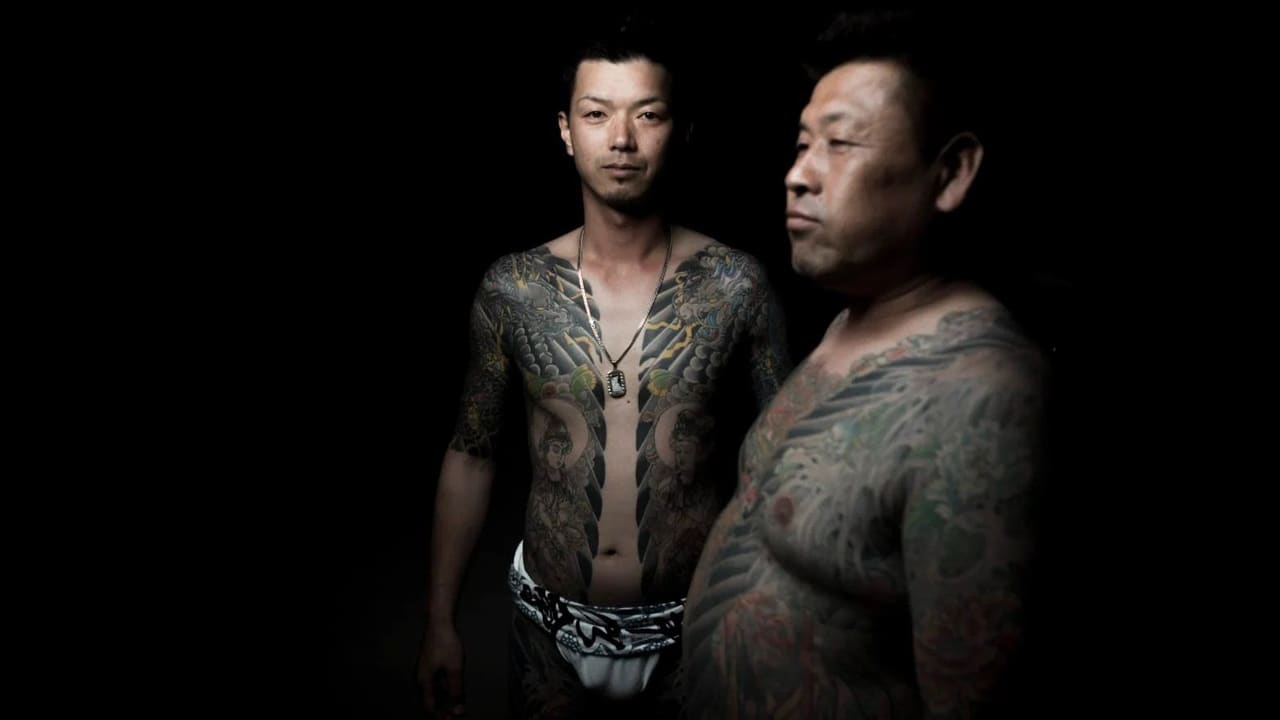
During the Edo era, tattooing experienced a great boom because, beyond being associated with outlaws (whose number was multiplying), this practice became widely popular. It was now a way to express oneself and to unite for more and more Japanese. Tattooing thus became decorative and is often shared. For example, two pieces of a design would be tattooed on two different people so they could form the complete tattoo only if they put those parts together.
That didn't mean tattooing enjoyed a better reputation. Punitive tattooing or that expressing social classes remained in the collective imagination and the practice was reprimanded. It was finally legalised in 1945 — notably thanks to Western societies' enthusiasm for Japanese-style motifs.
Today, tattooing is no longer so badly perceived, but the Japanese generally prefer small, discreet motifs to large ornaments. Some devotees and brave souls, for their part, are ready to go under the needles of traditional tattoo artists (no machine, then) to have their whole body covered.
Timeless Japanese motifs and their meanings
Traditional Japanese tattooing is an art in its own right. Sometimes used in small touches, it can also come in large pieces covering all or part of the human body. So it's not uncommon to see Japanese motifs adorning a back, an arm, a whole torso. Because of their specificity, the designs of traditional Japanese tattoo artists are grouped under a single name, "irezumi".
Some motifs are used more than others. Some have a stronger original meaning. We've selected 8 ideas for typically Japanese tattoos, and we'll explain what they'll say about you if you choose to have them inked.
The dragon
One of the most impressive creatures, the dragon is therefore unsurprisingly synonymous with power. Even if it can represent evil in the West, that's not the case in Asian countries. Master of the elements, the dragon is a symbol that commands respect, since it's protective.
The crane
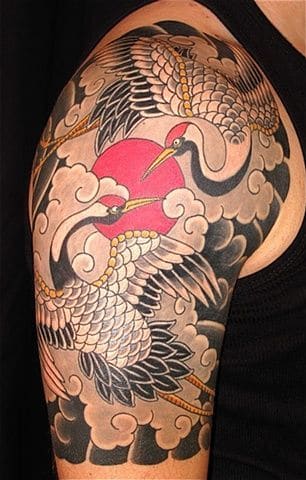
Also called the "bird of happiness", the crane is a much-appreciated motif in Japanese tattooing. Often depicted in full flight, the bird is a symbol of longevity and good fortune. Appreciated in Japanese art for its beauty, it's the central character of several fables and popular stories whose moral shows us that we must never give in to storms.
The samurai
The samurai is one of the most Japanese motifs! Coloured or not, behind a mask or with face uncovered, the depiction of the samurai has many variations. Always ready for battle, the samurai inspires honour, courage and a sense of sacrifice.
The Koi carp
It's not a simple fish you'll have tattooed if you choose a design depicting a Koi carp. Its symbol is very important for the Japanese, since it represents the notions of family, virility and perseverance. Values that are, moreover, favoured by the yakuza, who use it enormously in their body ornaments.
The Hannya mask
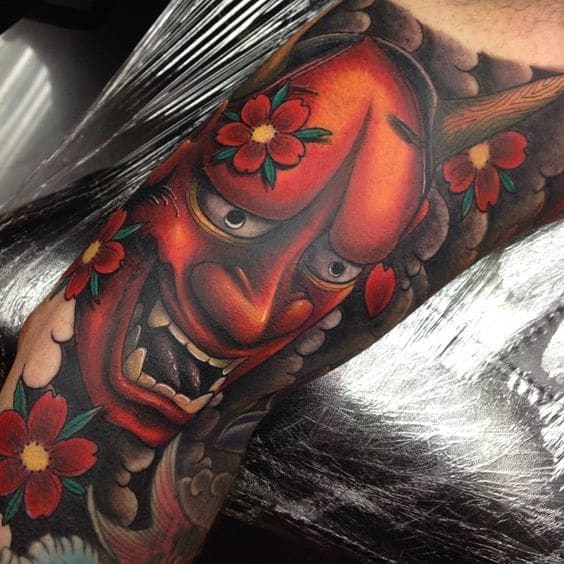
The Hannya mask represents the face of a female demon returned to Earth to take revenge for the harm men did to her. Revenge, pain and anger can be linked to this motif, which nonetheless remains one of the most impressive. It too is appreciated by criminal gangs, but also by women wanting to assert their strength of character.
The cherry blossom
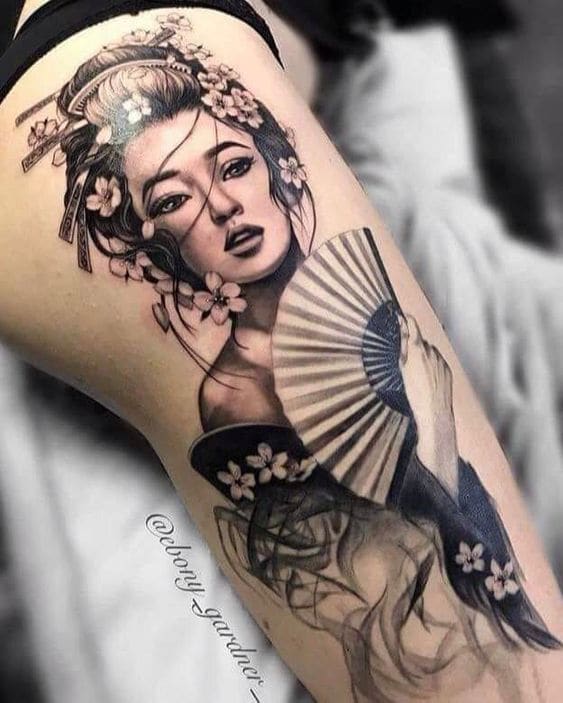
Sakura tattoos are full of delicacy. These flowers, which in real life are fleeting and fragile, convey the idea that life is short and beautiful, and that you must therefore make the most of it.
The chrysanthemum
While in France the chrysanthemum is a flower associated with death, it's nothing of the sort in Japan. It's even quite the opposite, since it's said to be the emperor's flower and would therefore evoke a higher social rank. Prestige and perfection will thus emanate from your tattoo.
The geisha
An object of fantasy, but above all a cultured, strong and refined woman, the geisha can be the idea for your future tattoo if you wish to take on these character traits.
Although history hasn't always valued this art, Japanese tattooing is nonetheless renowned for its motifs and the precision of its lines. So why not take the plunge and treat yourself to a tattoo that will represent your personality, among the many motifs?


