"Otonamaki" is a Japanese relaxation method, invented by the midwife Nobuko Watanabe.
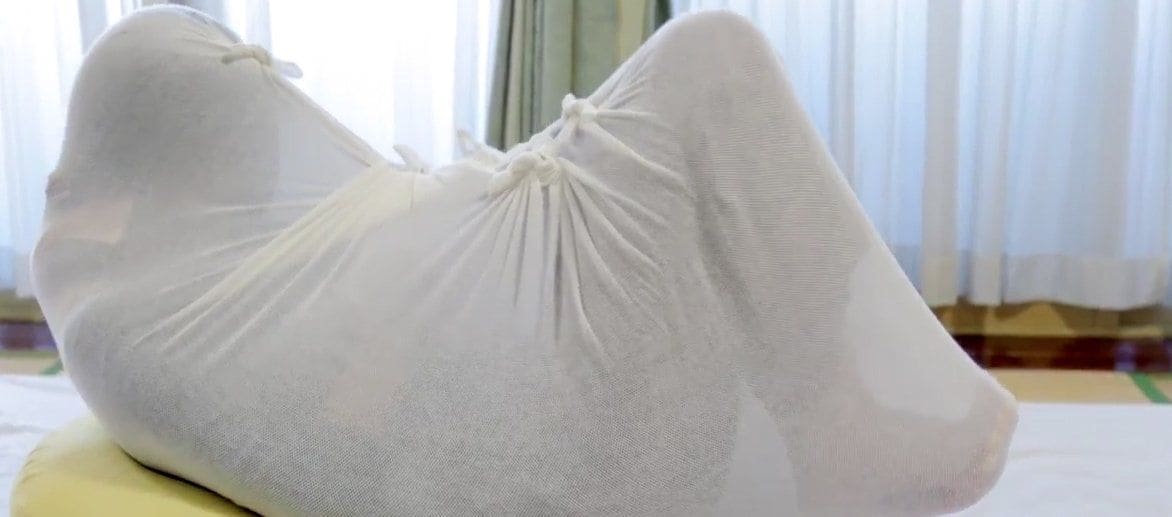
The principle is simple: using a large sheet, you wrap a person entirely so as to recreate the feeling of the "comfort of a foetus in its mother's womb". It's a large cocoon adapted to human size, formed from precisely placed knots and seams. For about twenty minutes, the instructor rocks and relaxes you. The sound of their voice guides and soothes, before reopening the sheet, with a sharp cut, using a pair of scissors.
A little history of otonamaki
It was in 2015 that Nobuko Watanabe developed otonamaki in Kyoto. A midwife, masseuse, but also head of the Toco institute in Kyoto, which supports women during their pregnancy and after their delivery, she designed her own method over seven years before defining the ideal position and making the most suitable fabric. At the time, she was looking for a way to relieve a group of young mums, who confided that they managed to relax by adopting this type of position.
The origin? Nobuko Watanabe's own mother is said to have suggested this method to her without knowing it, always saying that a child who grows up with a well-supported spine adopted a good posture for life. The creation of otonamaki also stems from an observation: the rise of Japanese executives in the 1980s who work excessively and find themselves unable to relax. She then thinks that good back support would be the key to complete relaxation.
The Japanese professionals who teach the practice often speak of a "feeling of well-being and security". This process doesn't only bring a feeling of fullness — it was created to improve postures, strengthen flexibility and relieve certain muscular or back problems. The art of otonamaki can even be aimed at certain athletes to allow them better physical rehabilitation. Some future parents even train in this method to then apply it to their newborn.
A problematic practice?
The otonamaki technique is debated among specialists.
Indeed, the many benefits are counterbalanced by the concern of certain practitioners. The chiropractor Shiro Oba explains that the practice can be risky for some people: "Asthmatics, for example, will have more difficulty feeling comfortable and breathing well in this kind of position."
It could also cause certain muscular problems instead of relieving them, according to a testimony from Visvanathan Ravi, a physiotherapist, to the BBC: "I completely disagree. If a person stays in this position for 30 minutes, I'm sure they'll have spinal problems. This practice is not recommended."
The facilitators who run the otonamaki workshops nonetheless specify: "Always keep a pair of scissors within reach. At the slightest problem, don't insist — cut the binding to free yourself," they advise. To each their own pace. The aim of the workshop is to train participants to reproduce otonamaki on their own. You learn the folding technique in pairs, then you're invited to learn a technique that lets you reproduce the action alone.
Now offered in around a hundred places across the Japanese archipelago, otonamaki proves effective even with teenagers. While the method isn't yet developed in France, Nobuko Watanabe would like to train Japanese nurses and midwives living in Europe.
In short, if you want to try this new method, you can go to several centres in Japan and spend about 3,000 yen to get started with this Japanese relaxation practice.