

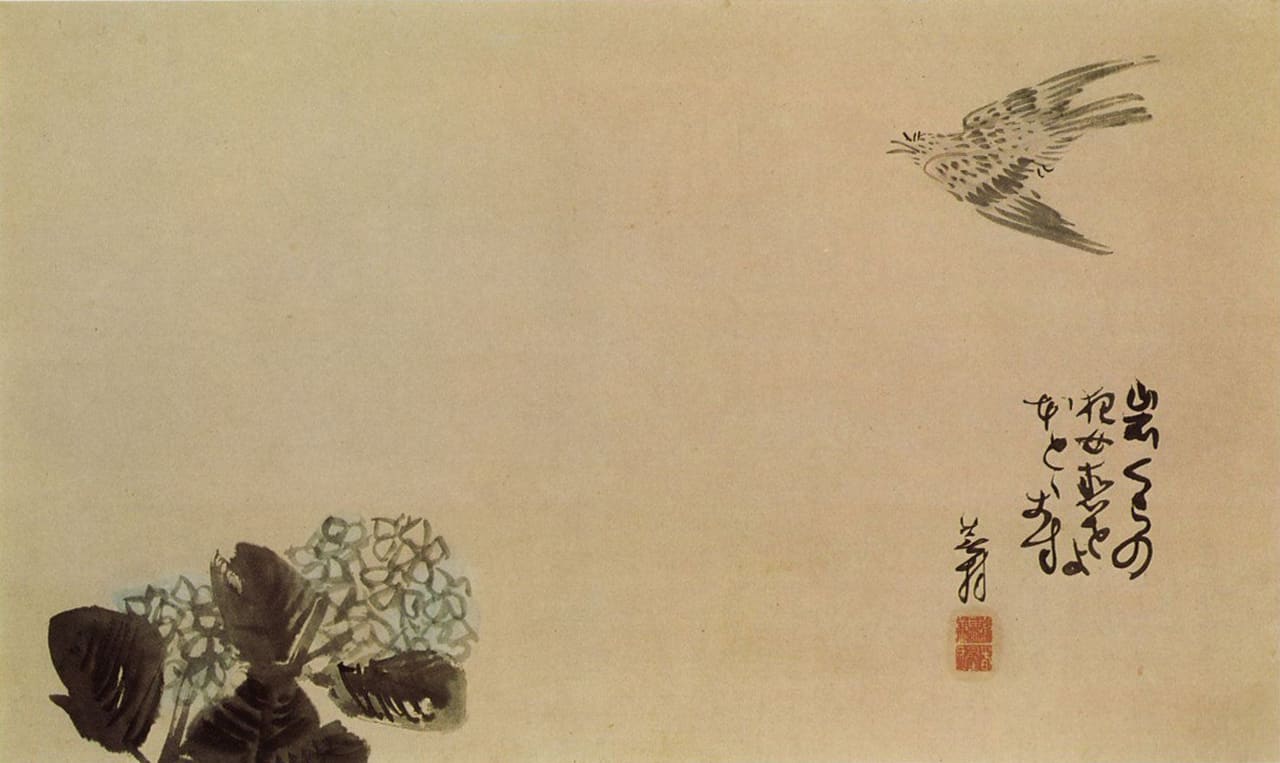
The haiku (俳句) is a Japanese form of poetry for noting emotions, the passing moment that delights or astonishes.
It's a very concise form — seventeen beats in Japanese (onji), in 3 verses (5-7-5), a limited number in other languages (English makes do with 3-5-3).
In French, the beats are replaced by syllables divided into three verses (a syllable has one or two beats):
- the first with 5 syllables,
- the second with 7 syllables,
- the third with 5 syllables.
A haiku doesn't necessarily include rhyme.
It can also include a caesura, which will serve to juxtapose two ideas.
Bashō Matsuo, poet, painter and Buddhist monk, is often considered the pioneer.
Celebrating the evanescence of things
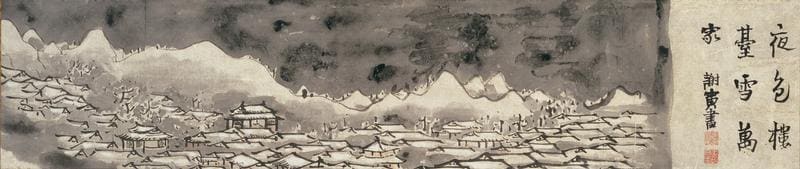
Born from poetic jousting between 17th-century poets, from a simplification of the Renga (a major literary art in medieval Japan), it was used in a comic and often vulgar way. It was Bashō Matsuo, poet, painter and Buddhist monk, who was the first to break with these practices and subvert the conventions to make it a subtle poetry.
For Bashō, the haiku isn't in the letter but in the heart. He strives to express the beauty contained in the simplest things of life. Through allusion, through the unsaid, he appeals to the reader's sensitivity.
3 other poets are often cited as the masters of haiku alongside Bashō: Yosa Buson, also the inventor of the haiga (painting accompanied by a haiku), Issa Kobayashi and Masaoka Shiki. They would all break with their predecessor by revisiting the haiku style to give it more freedom and depth.
- Masaoka Shiki — "I peel a pear / from the blade's edge / the sugary drip by drip."
- Unknown — "The glow of a blue sky / and the taste of your lips / trace my path."
- Yosa Buson — "When the north wind blows / the dead leaves / fraternise in the south."
- Kobayashi Issa — "A butterfly flutters / in a world / without hope."
- Matsuo Bashō — "On a dead branch / the crows have perched / autumn evening."
- Matsuo Bashō — "Nothing tells, / in the cicada's song, / that it's near its end."
- Masaoka Shiki — "Foolish, the 31st of December / just as foolish / New Year's Day."
This video clearly shows the importance of haiku in Japan, but also around the world.
Composing a haiku
To write a haiku, you must start by thinking about poem ideas. Then, you must write it with powerful details and detailed imagery. Make sure to polish it and listen to the sounds by saying it aloud so it's as melodious as possible.
FIND AN IDEA
> Observe nature. A river, a tree, a rock, a mountain, a bird, a lake... Take a walk, go for a hike or look at images on the internet (this article is written during lockdown) to find a scene or object that inspires you.
> You can also focus on a season and the natural events that occur at a certain time of year. Seasonal haiku often focus on a specific detail about the season by mentioning its name in the poem.
> Choose a specific person or object. You can imagine Proust's difficulty in talking about his madeleines in just 17 syllables. So focus on a single person or a single object in the poem.
> Read examples of haiku. You'll find many in books or, more simply, on the internet. I recommend the site http://www.unhaiku.com/chercher-un-haiku.html
> Focus on an experienced emotion, a past event, and look for a metaphor, with nature or whatever you like.
WRITE THE HAIKU
The haiku is a snapshot, a brief moment, but one that must be strong in emotion. In three lines, no room to write a novel! So transcribe a fleeting image.
> It doesn't necessarily have to rhyme; on the other hand it must imperatively follow the 5/7/5 syllabic structure. This means the first line has five syllables, the second seven syllables and the third five syllables.
> Call on your senses to describe the subject. Smell, touch, taste, sound or appearance will let you gain power. For example, you could write about "the musky smell of pine needles" or the "bitter taste of the morning air".
If you write about a particular subject, for example your dog, you could describe the clicking of its claws on the tiles or the feeling of its damp fur.
> Use concrete images and descriptions. You won't be able to make a long description or empty cliché sentences. Look for a description that seems unique to you while staying simple.
> The use of the present tense gives a feeling of immediacy, of a moment including the reader, more than a past narration.
> Surprise with an intriguing ending, which leaves room for imagination or philosophical reflection.
For example, the haiku by the Japanese poet Kobayashi Issa ends on a surprising line:
"Everything I touch
with tenderness, alas,
stings like brambles."
POLISH THE HAIKU
Read it aloud. It should feel natural. Check the syllables carefully, replace words that are too long or complicated. Then show it to others. Discover your readers' perception to better work on your messages.
Haiku inspires the world
There are many haiku enthusiasts around the world. Communities meet to exchange and compose together. In France, the magazine "Ploc!" of the 100% HAIKU association regularly publishes on the subject, as do the Association Francophone de Haïku or the site http://www.unhaiku.com/ which we mentioned above, and many others.
Above we saw that a style of painting was born to illustrate haiku: the haiga. But other artistic worlds draw their inspiration from the art of haiku.
Here, the extract from the creation of the composer and arranger Martin Gerigk, who draws heavily on nature and whose work "Haiku" is an experimental approach to pay tribute to the beauty of Japan and to the extraordinary art of Japanese haiku poetry from the 15th to the early 20th century.
Recently I found this France Culture programme on "What is the art of Haiku?"


