

Within Japanese culture, Sumo is a martial art in which fighters of impressive size practise wrestling during ritual bouts. It's one of the most popular sports in Japan and the national combat sport: several centuries old, this sport has a long history.
Let's discover together this ancestral Japanese sport, Sumo.
Good to know
In Japan, the term Sumotori, which is quite disrespectful, is little used: the term Rikishi is used more, meaning "gentleman" and "strength", a way of showing respect for this sacred fighter.
Sumotori and bouts
The sumotori's outfit
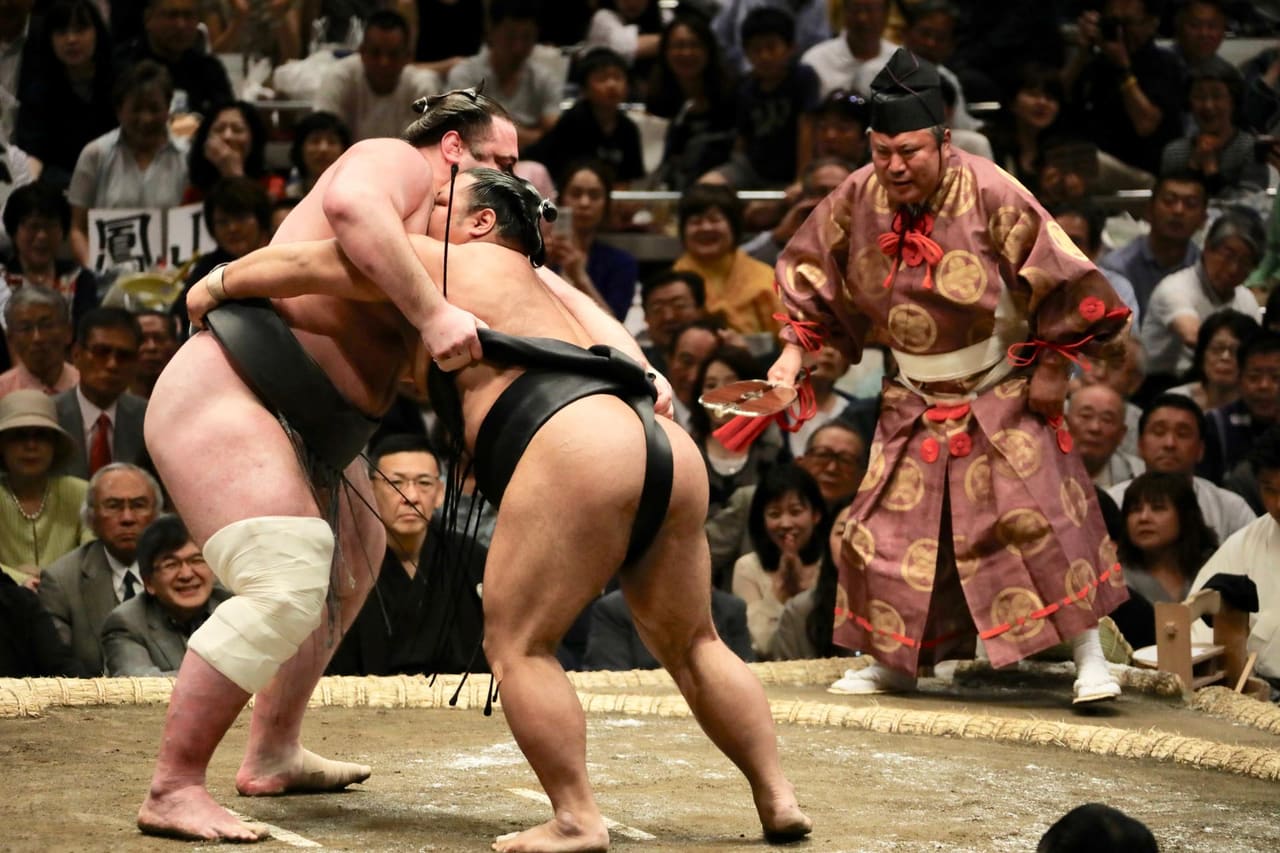
At the time of the bouts, the sumo wrestlers wear a mawashi, a strip of fabric tightened around the waist and groin. It's the only solid grip allowed during the fight.
Their hair is styled in the chonmage style: held in a bun, the hair is smoothed and oiled.
Good to know
A sumotori keeps his hair long throughout his active career; when he retires, a ceremony is held during which this chonmage is cut.
The daily life of the rikishi:
Their daily life is very regulated. They wake up at 5:30 or 6 am, train on an empty stomach, eat, take a nap and dine. The wrestler ingests an average of 5,000 kcal a day. The rikishi are used to consuming extremely rich food in order to gain weight. Most rikishi thus reach 140 kilos, but they can go up to 220 kilos, which sharply decreases their life expectancy.
The training follows a number of ancestral rituals.
The stables
Most stables (the place where the wrestlers, the rikishi, train, but also where they live together) occupy a single building; the training hall is on the ground floor and the living areas on the upper floors. The lower-division wrestlers share a dormitory, while the more experienced ones have an individual room. In principle, a wrestler can only emancipate himself from this collective life once he's become a sekitori, and if he's married.
Within the stable, a very strict hierarchy applies: the youngest serve and assist the eldest. There are six ranks within the sumo hierarchy. The rare chosen ones who reach the highest, the yokozuna, gain a quasi-divine status. The yokozuna keeps his title for life and sees his name enter history.
The Sumo bout: rites and basic rules
Sumo is a sport reserved for men, women's blood being deemed impure to practise it.
There's no weight category for the rikishi. It can happen that one of the fighters is more than double the weight of the other (rikishi weights can range from 70 to 280 kg). On average, the rikishi of the top divisions weigh about 150 kg.
These wrestlers fight on the Dohyō (the ring) barefoot. The Dohyō symbolises the sky and measures 6 m². The wrestling itself takes place in the 4 m-diameter circle at the centre of the Dohyō. Above this ring hangs a suspended roof, recalling a Shinto temple and making the arena a sanctuary: the bout is dedicated to the gods.
Rules of a sumo bout:
- The bout is won when the opponent is pushed out of the inner circle or by making him fall onto the Dohyō (only his feet must touch the ground; if another part of the body touches the ground, the bout is lost).
- It's forbidden to punch, kick above the hips, strangle and pull hair.
- So you fight with grips, with destabilising palm strikes and by using your weight or that of the opposing Rikishi.
In training, stretching is paramount; despite its power, sumo is above all technical. The wrestler has eighty-two different grips at his disposal and trains daily to master them.
There are 6 major tournaments a year in Japan. Each Rikishi fights every day for 15 days. The tournament winner is the one with the better win/loss ratio. At the end of the tournament, this sumotori receives the Emperor's trophy.
History of Sumo:
Until the Japanese kept their writings in the 8th century, it's impossible to know exactly when sumo developed in Japan.
However, ancient murals tell us that these origins are really very ancient.
A thousand-year-old tradition, sumo is said to have appeared some 1,500 years ago. The first trace of its existence appears in 712 in a book, one of the first written works in Japanese.
During the 8th century, Sumo was introduced to the imperial court and an annual wrestling festival was organised. Thus, Sumo is no longer an agrarian ritual, but a global ritual of peace and prosperity.
Sumo was then adapted into a martial art under the reign of Emperor Saga (9th century), and the warrior class began to practise this sport from the 12th century, as several great military leaders of Japan were sumo enthusiasts.
During the 17th century, the sumotori became professional and became entertainment for the bourgeois classes of the population.
Good to know
Sumo was initially violent, with no forbidden blows — often a real fight to the death.
If you want to learn more about Sumo and see how it goes there, we recommend this video!


